Meet Axle, your autonomous Applications Engineer.
Axle turns technical RFQs into engineered, priced quotes. It understands the application, selects and configures the right products, runs required sizing calculations, builds the BOM, gets vendor pricing, validates the solution, and prepares the quote for review.
Built for industrial distributors, manufacturers and reps.
| Design flow | 300 GPM |
| Total dynamic head | 180 ft |
| Fluid | Produced water, SG 1.05, 95°F |
| Solids | See note 4 |
| Wetted materials | 316 SS |
| Power | 460 V / 3 ph / 60 Hz |
- Flow: 300 GPMemail + spec p.2
- Head: 180 ft TDHemail + spec p.2
- Fluid: produced water, SG 1.05, 95°Fspec p.2
- Wetted materials: 316 SSemail + spec p.2
- Power: 460 V, 3 ph, 60 Hzemail
- Environment: outdoor, Karnes Countyemail
- Needed by: Fridayemail
ANSI B73.1 end-suction process pump, 3x2-10, 316 SS
25 HP TEFC motor, 460 V, 3,560 RPM. Single mechanical seal, Plan 11. Fabricated steel baseplate, coupling guard.- ✓NPSH margin: NPSHa 22 ft, NPSHr 9 ft at duty13 ft margin
- ?NPSHa assumes flooded suction, pending customer answerassumption
- ✓Motor: 20.3 BHP at duty, 25 HP selected, 81% loaded; runout stays inside the service factorSF 1.15
- ✓Duty inside 80 to 110% of BEP91% of BEP
- ✓Materials: 316 SS casing, impeller, shaft sleevemeets spec
- ✓Seal plan 11 per customer standard ES-204standard applied
- ✓Outdoor: TEFC motor, epoxy coating, drain plugsaccessory rule
| # | Item | Qty | Vendor cost | Source | Lead | Sell |
|---|---|---|---|---|---|---|
| 1 | Pump, ANSI 3x2-10, 316 SS | 1 | $6,120 | vendor quote · today | 4 wk | $7,650 |
| 2 | Motor, 25 HP TEFC, 460 V | 1 | $2,150 | price file · Sep 2026 | stock | $2,690 |
| 3 | Baseplate, fabricated steel | 1 | $880 | vendor quote · today | 4 wk | $1,100 |
| 4 | Mechanical seal, Plan 11 | 1 | $610 | was 41 days old, refreshed | 2 wk | $760 |
| 5 | Coupling and guard | 1 | $290 | price file · Sep 2026 | stock | $365 |
| 6 | Isolation valves, 3" and 2", 316 SS | 2 | $740 | price file · Sep 2026 | stock | $925 |
| 8 more lines: seal support, gauges, check valve, flex connectors, anchors, grout, startup, freight | ||||||
- ✓Every extracted requirement covered by the selection7 of 7
- ✓Wetted materials match spec316 SS
- ✓Duty inside allowable operating region91% BEP
- ✓NPSH margin at or above 3 ft13 ft
- ✓Motor within service factor to runout25 HP, SF 1.15
- ✓Seal plan matches customer standardES-204
- ✓BOM complete per accessory rules for outdoor install14 lines
- ✓All vendor pricing under 30 days old1 refreshed
- ✓Margin at or above floor20.0%
- ✓Lead time inside requested date4 wk of 6
- ✓Option compatibility (motor, seal, coupling)valid
Confidence: high. Ready for review.
Every number on this quote traces to the email, the spec, the curve library, a dated vendor quote, or your price file. Nothing was estimated.Quote Q-1184 is ready for your approval.
11 of 11 checks passed. One assumption open, flagged above. Margin 20.0%, above floor.
From RFQ to engineered quote.
The customer sends what they always send. Axle does the applications-engineering work in between, and hands your engineer a finished quote to approve.
Customer sends
- An email or formal RFQ
- Technical specifications
- Datasheets and spreadsheets
- Site conditions, deadlines, and preferences
Axle does the work
Engineer reviews
- Quote, proposal or submittal, ready to send
- BOM with every line traced to its source
- Assumptions and open questions, listed
- ERP and CRM records updated on approval
Your best engineers shouldn't spend their day building quotes.
Applications Engineers are the scarcest people in a technical sales organization. Most of their week goes to work that doesn't need their judgment.
Where the hours go
- Reading RFQs, emails and spec packages line by line
- Searching catalogs and selection tools
- Digging up the last job like this one
- Building the BOM, accessory by accessory
- Requesting and chasing vendor pricing
- Copying data between email, ERP, CRM and Excel
- Assembling the quote document and the submittal package
What it costs
- Slow response times on the opportunities that reward speed
- RFQs that never get quoted because the queue is full
- Expensive engineering capacity spent on data entry
- Dependence on two or three senior people who hold the knowledge
- Growth that requires hiring engineers you can't find
Axle adds Applications Engineering capacity without adding headcount.
What is an autonomous Applications Engineer?
A system that can receive a technical customer request and perform the applications-engineering work around it: understand the application, engineer the solution, source and price it, validate it, and deliver the quote. How much of that runs without a human is your decision, per class of work.
Review every job
Axle does the work. An engineer reviews everything before it goes out. This is the default for every new deployment.
Review exceptions
Axle handles standard work end to end and escalates anything outside the rules: unfamiliar applications, failed validations, margin below floor, missing information.
Autonomous standard applications
Approved, repeatable classes of work execute automatically, with the audit trail intact. You choose which classes, and you can pull any of them back to Level 1 at any time.
Six stages. One job.
Understand
Reads RFQs, emails, specifications, datasheets and spreadsheets. Extracts the application and flags what is missing.
Engineer
Selects products, configures the solution, runs calculations, sizes equipment where the application requires it, and builds the BOM.
Source
Gets cost, availability, lead time and supplier information for every line, with the date on it.
Price
Applies customer pricing, contract discounts, margin requirements and your commercial rules.
Validate
Checks engineering constraints, compatibility, specifications, pricing, margin and every assumption it made.
Deliver
Generates the quote, proposal or submittal in your format and updates ERP, CRM or whatever runs your business.
AI shouldn't guess when engineering matters.
Axle doesn't produce an answer and hope. It combines AI reasoning with the things that make engineering work trustworthy, and shows its evidence.
"How would AI let me know when it's not sure?"
What Axle reasons with
- Deterministic calculations, not model arithmetic
- Manufacturer and product configuration rules
- Engineering constraints for the application
- Your historical approved jobs
- Customer-specific specifications and standards
- Source evidence attached to every value
- Escalation to a human when confidence is low
What Axle validates before review
- Application requirements against the selection
- Product compatibility across the BOM
- Sizing and calculation results
- Configuration rules and option validity
- Customer specifications and approvals
- Pricing, margin, availability and lead time
- Unresolved assumptions, listed for the engineer
Axle doesn't just produce an answer. It shows why the answer is correct. When it isn't confident, it asks.
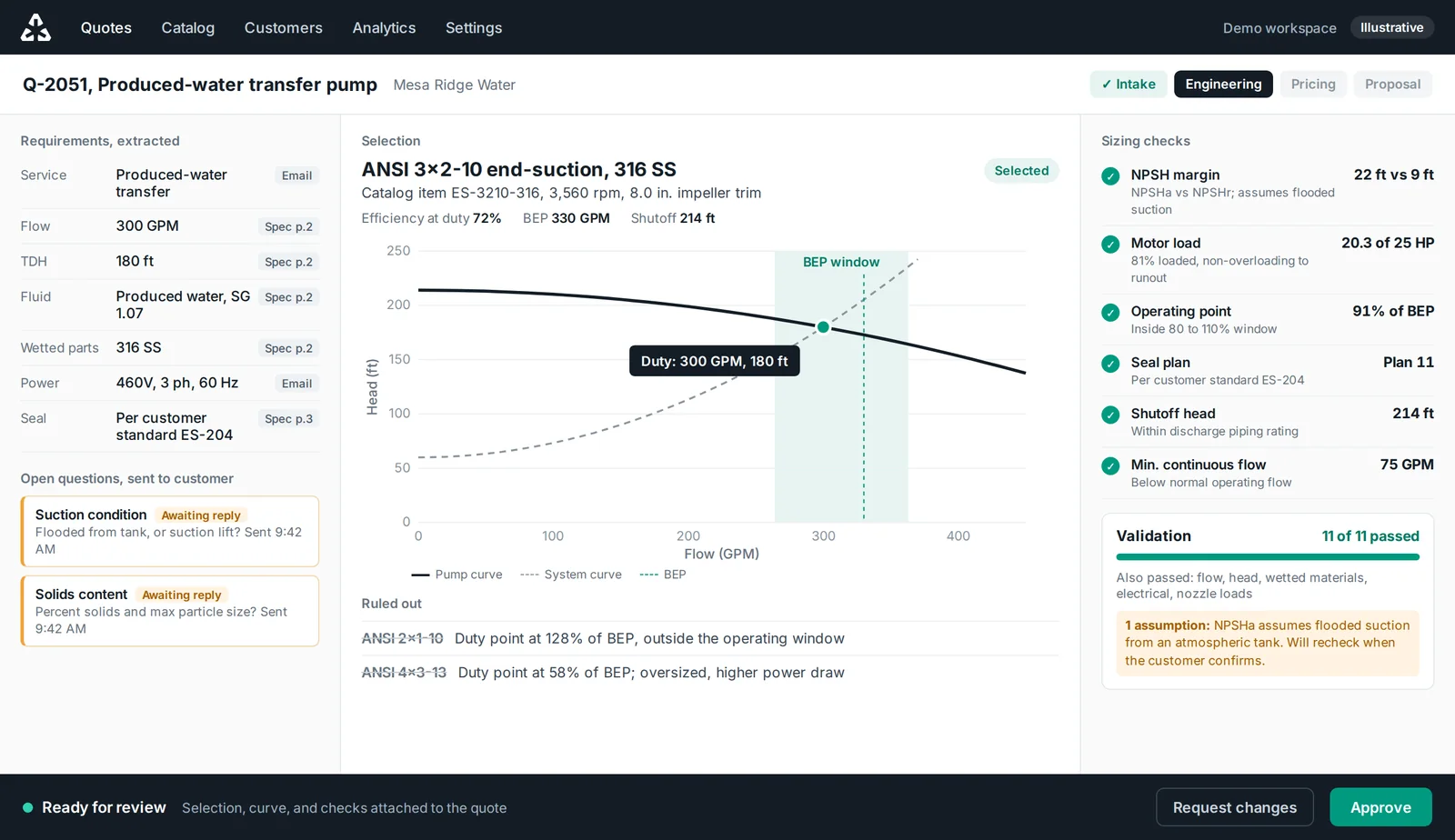
The engineering stage as the engineer sees it: every requirement with its source, the selection on the curve, the candidates ruled out and why, the checks with their values, and the one thing Axle wasn't sure about, flagged.
Turn your best engineer's experience into company knowledge.
Every industrial company depends on a few people who know what actually works in the field: the vendor quirks, the customer preferences, the substitutions, the configuration rules that aren't in any catalog. Axle learns that knowledge and applies it on every job.
Axle learns from
- Product catalogs and manufacturer manuals
- Historical RFQs and the quotes that answered them
- Final BOMs, as sent
- Customer standards and specifications
- Your engineering and commercial rules
- Engineer corrections on Axle's drafts
- Win, loss and outcome data where you track it
So the whole team quotes like the veteran
- The right substitution when the specified part is on backorder
- The accessory the customer always needs and never lists
- The vendor whose lead times slip in Q4
- The configuration that failed in the field last year
- The customer who requires a specific seal plan on every pump
Every approved application makes Axle more useful on the next one.
Your engineers make the decisions where expertise matters most.
Axle handles
- Routine RFQ review and requirements extraction
- Catalog research and product selection
- Standard sizing and configuration
- BOM creation
- Vendor pricing, availability and lead time
- Quote, proposal and submittal preparation
- Documentation and system updates
Applications Engineers focus on
- Difficult and novel applications
- Ambiguous requirements and the customer conversation
- High-risk engineering decisions
- Unusual failures and exceptions
- Strategic recommendations
- Final approval, wherever you require it
Axle isn't designed to eliminate engineering judgment. It's designed to stop wasting it.
More quotes out. Fewer hours in.
What changes when the applications-engineering work stops waiting on your busiest people.
Revenue
- Quote more of the opportunities you already receive
- Respond in hours, not days
- Stop losing RFQs to the queue
- Add sales and application capacity without waiting on a hire
Cost
- More output per Applications Engineer
- Repetitive research and data entry removed
- Growth without equivalent headcount growth
- New hires productive in weeks, not quarters
Margin
- Current vendor costs on every line
- Consistent customer pricing
- Margin rules enforced, not remembered
- Valid alternatives surfaced when they're better
Risk
- Engineering validations on every job
- Rules applied the same way every time
- Institutional knowledge that doesn't retire
- Full audit trail and human review thresholds
At Axle's first deployment, an industrial supply house in South Texas, every proposal goes out the same day the request arrives.
Built for technical industrial sales, wherever the product has to be engineered to the application.
Pumps & Fluid Handling
Centrifugal, positive displacement, metering and submersible pumps, selected and sized to the duty point.
Compressors & Rotating Equipment
Reciprocating, rotary screw and centrifugal packages, blowers and vacuum, engineered to the gas and the duty.
Valves & Flow Control
Control, isolation, safety and specialty valves with the right trim, actuation and accessories.
Instrumentation & Controls
Transmitters, switches, analyzers and accessories matched to process conditions, signals and hazardous-area requirements.
Industrial Automation
PLCs, HMIs, drives, panels and I/O configured to the control narrative and the electrical requirements.
Electrical & Power
Motors, switchgear, MCCs, transformers and distribution equipment selected to load, voltage and site conditions.
The engines are the same for every customer. What's configured is yours: your catalog, your specs and standards, your templates, your pricing rules, and the way your team already works. If your quotes require engineering the product to the application, Axle fits. How that works →
Axle works inside the systems you already use.
No new system for your engineers to live in. Axle reads from and writes to the tools that already run your business, scoped during onboarding to what you actually run.
Connectors are configured per deployment. Where a system has no API, Axle works from the exports and files you already produce.
Your data stays yours.
- Encrypted in transit and at rest
- Every customer's data logically isolated
- Role-based permissions and account controls
- Audit trail of every draft, edit, approval and send
- Human approval thresholds you set, per class of work
- No training of general models on your data
- Published subprocessor list and 48-hour breach notification
- Data returned or deleted on request
Put an autonomous Applications Engineer on every RFQ.
Process more opportunities. Respond faster. Give your experts their time back. Book thirty minutes and bring a recent RFQ; we'll walk through what Axle does with it.
Or send a note.
We'll reach out shortly to set up your demo. If it's urgent, email hello@getaxle.ai.